Aaranyak-BAT installs solar lights in hotspots of human-elephant conflict
 |
With support from the British Asian Trust, Aaranyak is taking a community-centric approach to address human-elephant conflict in six high incidence districts of Assam and Meghalaya, where over 90 people have lost their lives in the last six months.
“Aaranyak is working with local communities to create change which helps protect both people and elephants,” says Aaranyak’s senior scientist Dr Bibhuti Prasad Lahkar.
Most of the villages affected by elephants are located in remote parts of the state with poor roads, communication, inadequate electricity connection and erratic power supply.
Villagers, especially women and children, are often scared of going out of their houses after dusk in fear of encountering wild elephants that may have strayed into their villages. Lack of lighting facilities make those nights eerie.
Prominent research-based biodiversity conservation organisation of the region, Aaranyak (www.aaranyak.org), in collaboration with Assam Forest Department, has been working on mitigating human-elephant conflicts in several parts of Assam through various measures taking the community along.
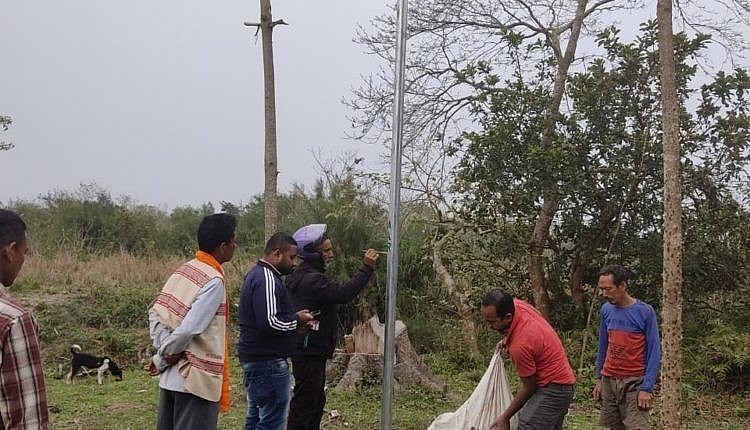
Besides organising sensitization campaigns for the community and other stakeholders on how to go about mitigating the conflict, and supplementing livelihood of the conflict-affected people, Aaranyak has installed solar-powered fencing in hotspots where there has been conflict between people and wild elephants. Solar lights have also been installed in some villages so villagers can sight wild elephants from a safe distance at night and take immediate measures to remain safe and protect their lives and property as much as possible.
With support from the British Asian Trust via a UK Government Darwin initiative grant, Aaranyak is delivering a project promoting coexistence of human beings and wild elephants in some of the conflict hotspot, an additional 90 solar street lights have been purchased for some of the areas in eastern Assam.
Seventy-three solar street lights have already been installed in villages in Jorhat, Sivasagar, Dibrugarh and Tinsukia districts, with 17 more such lights to be installed in Majuli district.
In Jorhat district, solar street lights have been installed in the following villages: Sagunpara (7 units), Hatisal (5), Sumani Chapori (1), Major Chapori (1), Bejorchiga (5), Koibartagarh (1).
In Sadia sub-division of Tinsukia district solar street lights have been set up in Padumfula (5), Na-Basa Gaon (4), No. 2 Bacha Gaon (5), Hallow Gaon (1).
India’s Northeast region, a part of the Indo-Burma biodiversity hotspot, is home to over 20 percent of Asia’s wild elephants’ population. Loss of habitat and encroachment into forest areas bring elephants and human beings into contact that leads to conflict as they compete for the same space.
The British Asian Trust’s conservation work focused on protecting wildlife and their habitats, with reducing conflict between people and wildlife a key area of focus. The charity has partnered with Aaranyak to work with local communities to find solutions that work for both people and wildlife.
The post Aaranyak-BAT installs solar lights in hotspots of human-elephant conflict appeared first on Vietexplorer.com.
View more from VietExplorer:
Vietnamese installation from London design festival to be exhibitedRoK, Vietnamese artists pay tribute to ‘unending inspiration’
Puppeteers breathe new life into puppetry art
French artists host art exhibition in HCM City
Miss Vietnam 2020 suffers postponement over COVID-19 fears
A look at traditional northern cuisine during Tet
Vietnam presides over ASEAN Women’s Circle in Washington D.C
Religious sites throughout Hanoi re-open for tourists
Dinh Linh finishes among Top 16 of Manhunt International 2019
Nguyen Hue flower street gears up to open to public from January 22
Hanoi streets adorned with Ban flowers in full bloom
Hanoi student dormitories transformed into isolation areas
COVID-19 isolation area set up close to Tan Son Nhat Int’l Airport
Exploring lush Pu Luong Nature Reserve in Thanh Hoa
Exploring picturesque ripening paddy fields of Long An
Discovering underwater sea path of Quy Nhon
Stunning Vietnamese images displayed in Sony World Photography Awards
Young people flock to witness ox-eye daisy gardens in Hanoi
Exploring Mu Cang Chai during winter
Picturesque giant sand dunes of Quy Nhon

Nhận xét
Đăng nhận xét